NEW QUESTION 17
Click the Exhibit button.
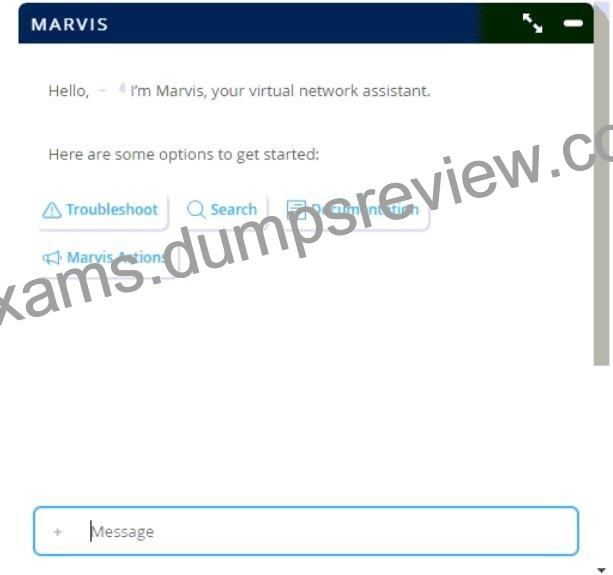
Referring to the exhibit, which Marvis language would you use to query Mist about an issue?
Referring to the exhibit, the Marvis language that you would use to query Mist about an issue is natural language. Natural language is the language that humans use to communicate with each other, such as English, Spanish, or Hindi. Natural language is different from formal or programming languages, such as SQL, Python, or query language, which have strict rules and syntax.
Marvis is a virtual network assistant that allows you to interact with the Mist network using natural language commands. You can type or speak your queries to Marvis in plain English and get answers in a conversational manner. For example, you can ask Marvis questions like “Why is my Wi-Fi slow?” or “How many devices are connected to AP1?” or “Show me the throughput of SSID2”. Marvis will understand your intent and provide relevant information, insights, and actions.
Marvis uses natural language processing (NLP) to analyze and interpret your queries. NLP is a branch of artificial intelligence that deals with the interaction between computers and human languages. NLP involves various tasks, such as speech recognition, natural language understanding (NLU), natural language generation (NLG), sentiment analysis, machine translation, etc.
NEW QUESTION 19
You want to obtain detailed information on a wireless client.
In this scenario, which area would you use to accomplish this task?
The area that you would use to obtain detailed information on a wireless client is the Insights area. The Insights area provides a comprehensive view of the wireless network performance and user experience, including the client dashboard, the live view, the service-level expectations (SLEs), and the Marvis virtual network assistant.
The client dashboard allows you to view and search for individual wireless clients and see their connection details, such as device type, MAC address, IP address, SSID, AP name, signal strength, throughput, data usage, location, and more. You can also perform actions on the clients, such as block, unblock, or capture packets.
The live view allows you to monitor the real-time status and activity of the wireless network and clients. You can see the number of connected clients, the traffic volume, the SLE scores, the top APs and SSIDs, and more. You can also filter and drill down into specific clients, APs, SSIDs, or sites.
The SLEs allow you to define and measure the quality of service and user experience for the wireless network. You can set thresholds and goals for key metrics, such as throughput, coverage, capacity, roaming, uptime, and WAN. You can also receive alerts and recommendations when the SLEs are violated.
The Marvis virtual network assistant allows you to interact with the wireless network using natural language commands. You can ask questions, troubleshoot issues, perform actions, and get insights from Marvis. For example, you can ask Marvis to show you the details of a wireless client or to explain why a client had a poor connection.
NEW QUESTION 21
Besides providing AP configuration status, for which other purpose is the LED used in the location design phase?
According to the web search results, the LED on a Mist AP can be used for antenna orientation in the location design phase, besides providing AP configuration status. The location design phase is the process of planning and deploying a wireless network that can provide accurate and reliable location services, such as indoor positioning, wayfinding, or asset tracking1. Antenna orientation is an important factor that affects the performance and accuracy of location services, as it determines the coverage and signal strength of the APs2.
The LED on a Mist AP can be used to indicate the antenna orientation by showing different colors and patterns depending on the angle of the AP3. For example, a blue LED means that the AP is facing down, a green LED means that the AP is tilted at 45 degrees, and a red LED means that the AP is facing up3. By using the LED as a guide, the network installer can easily adjust the angle of the AP to achieve the optimal coverage and location accuracy3. The LED can also be controlled remotely by using the Mist AI app or the Mist portal3.
Therefore, based on the web search results, the LED on a Mist AP can be used for antenna orientation in the location design phase, besides providing AP configuration status. This feature can help improve the quality and efficiency of location services in various scenarios, such as retail, hospitality, or healthcare1.
NEW QUESTION 27
Which two APIs are supported by Mist? (Choose two.)
According to the web search results, the two APIs that are supported by Mist are webhook and REST. A webhook is a way of sending data from the Mist cloud to a third-party application or service when a certain event occurs1. A webhook can be used to integrate Mist with various platforms, such as Slack, Splunk, ServiceNow, or Zapier1. A webhook can also be used to trigger custom actions, such as sending notifications, creating tickets, or updating databases1. You can configure webhooks in the Mist portal by selecting the organization, site, and event type that you want to send data to1.
A REST (Representational State Transfer) is a way of accessing and manipulating data from the Mist cloud using HTTP requests and responses2. A REST API can be used to perform various tasks, such as creating and managing organizations, networks, sites, devices, users, and policies2. A REST API uses JSON or XML as the data format and supports different HTTP methods, such as GET, POST, PUT, and DELETE2. You can use the REST API to automate and customize your Mist environment according to your needs2. You can access the REST API documentation in the Mist portal by clicking on the ? mark in the upper right of the UI2.