[Aug 23, 2026] New Microsoft DP-600 Dumps with Test Engine and PDF (New Questions) [Q57-Q71]

5/5 - (1 vote)

[Aug 23, 2026] New Microsoft DP-600  Dumps with Test Engine and PDF (New Questions)

Pass Your DP-600 Exam Easily – Real DP-600 Practice Dump Updated

Microsoft DP-600 Exam Syllabus Topics:

Topic Details
Topic 1
  • Implement and manage semantic models: This section of the exam measures the skills of architects and focuses on designing and optimizing semantic models to support enterprise-scale analytics. It evaluates understanding of storage modes and implementing star schemas and complex relationships, such as bridge tables and many-to-many joins. Architects must write DAX-based calculations using variables, iterators, and filtering techniques. The use of calculation groups, dynamic format strings, and field parameters is included. The section also includes configuring large semantic models and designing composite models. For optimization, candidates are expected to improve report visual and DAX performance, configure Direct Lake behaviors, and implement incremental refresh strategies effectively.
Topic 2
  • Maintain a data analytics solution: This section of the exam measures the skills of administrators and covers tasks related to enforcing security and managing the Power BI environment. It involves setting up access controls at both workspace and item levels, ensuring appropriate permissions for users and groups. Row-level, column-level, object-level, and file-level access controls are also included, alongside the application of sensitivity labels to classify data securely. This section also tests the ability to endorse Power BI items for organizational use and oversee the complete development lifecycle of analytics assets by configuring version control, managing Power BI Desktop projects, setting up deployment pipelines, assessing downstream impacts from various data assets, and handling semantic model deployments using XMLA endpoint. Reusable asset management is also a part of this domain.
Topic 3
  • Prepare data: This section of the exam measures the skills of engineers and covers essential data preparation tasks. It includes establishing data connections and discovering sources through tools like the OneLake data hub and the real-time hub. Candidates must demonstrate knowledge of selecting the appropriate storage type—lakehouse, warehouse, or eventhouse—depending on the use case. It also includes implementing OneLake integrations with Eventhouse and semantic models. The transformation part involves creating views, stored procedures, and functions, as well as enriching, merging, denormalizing, and aggregating data. Engineers are also expected to handle data quality issues like duplicates, missing values, and nulls, along with converting data types and filtering. Furthermore, querying and analyzing data using tools like SQL, KQL, and the Visual Query Editor is tested in this domain.


QUESTION 57
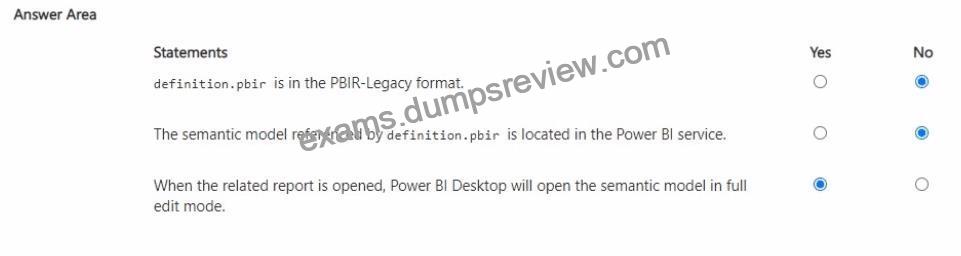
You have a Microsoft Power Bl project that contains a file named definition.pbir. definition.pbir contains the following JSON.
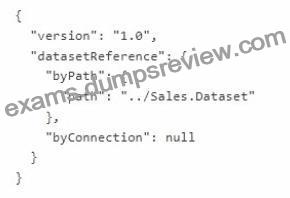
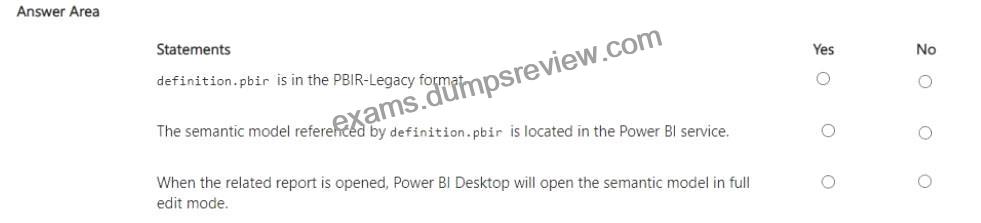
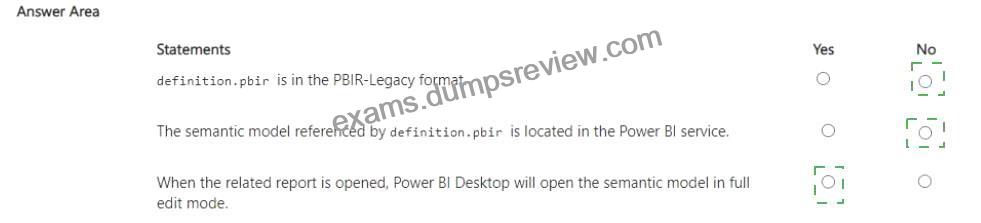
For each of the following statements, select Yes if the statement is true. Otherwise, select No.
NOTE: Each correct selection is worth one point.
QUESTION 58
You have a Fabric tenant tha1 contains a takehouse named Lakehouse1. Lakehouse1 contains a Delta table named Customer.
When you query Customer, you discover that the query is slow to execute. You suspect that maintenance was NOT performed on the table.
You need to identify whether maintenance tasks were performed on Customer.
Solution: You run the following Spark SQL statement:
REFRESH TABLE customer
Does this meet the goal?


QUESTION 59
You have a Fabric tenant that contains 30 CSV files in OneLake. The files are updated daily.
You create a Microsoft Power Bl semantic model named Modell that uses the CSV files as a data source. You configure incremental refresh for Model 1 and publish the model to a Premium capacity in the Fabric tenant.
When you initiate a refresh of Model1, the refresh fails after running out of resources.
What is a possible cause of the failure?


QUESTION 60
You have a Fabric workspace named Workspacel that uses the Premium Per User (PPU) license mode and contains a semantic model named Model!.
Large semantic model storage format is selected for Model 1.
You need to ensure that tables imported into Modell are written automatically to Delta tables in OneLake.
What should you do for Modell and Workspacel? To answer, select the appropriate options in the answer area.
NOTE: Each correct selection is worth one point.

QUESTION 61
You need to create a data loading pattern for a Type 1 slowly changing dimension (SCD).
Which two actions should you include in the process? Each correct answer presents part of the solution.
NOTE: Each correct answer is worth one point.


QUESTION 62
You need to create a DAX measure to calculate the average overall satisfaction score.
How should you complete the DAX code? To answer, select the appropriate options in the answer area.
NOTE: Each correct selection is worth one point.

QUESTION 63
You need to design a semantic model for the customer satisfaction report.
Which data source authentication method and mode should you use? To answer, select the appropriate options in the answer area.
NOTE: Each correct selection is worth one point.

QUESTION 64
You have a Fabric tenant that contains a lakehouse named Lakehouse1. Lakehouse1 contains a table named Nyctaxi_raw. Nyctaxi_raw contains the following columns.

You create a Fabric notebook and attach it to lakehouse1.
You need to use PySpark code to transform the dat
a. The solution must meet the following requirements:
* Add a column named pickupDate that will contain only the date portion of pickupDateTime.
* Filter the DataFrame to include only rows where fareAmount is a positive number that is less than 100.
How should you complete the code? To answer, select the appropriate options in the answer area. NOTE: Each correct selection is worth one point.

QUESTION 65
You have an Azure Data Lake Storage Gen2 account named storage! that contains a Parquet file named sales.
parquet.
You have a Fabric tenant that contains a workspace named Workspace1.
Using a notebook in Workspace1, you need to load the content of the file to the default lakehouse. The solution must ensure that the content will display automatically as a table named Sales in Lakehouse explorer.
How should you complete the code? To answer, select the appropriate options in the answer area.
NOTE: Each correct selection is worth one point.

QUESTION 66
You have a data warehouse that contains a table named Stage. Customers. Stage-Customers contains all the customer record updates from a customer relationship management (CRM) system. There can be multiple updates per customer You need to write a T-SQL query that will return the customer ID, name, postal code, and the last updated time of the most recent row for each customer ID.
How should you complete the code? To answer, select the appropriate options in the answer area, NOTE Each correct selection is worth one point.

QUESTION 67
Case Study 1 – Contoso
Overview
Contoso, Ltd. is a US-based health supplements company. Contoso has two divisions named Sales and Research. The Sales division contains two departments named Online Sales and Retail Sales. The Research division assigns internally developed product lines to individual teams of researchers and analysts.
Existing Environment
Identity Environment
Contoso has a Microsoft Entra tenant named contoso.com. The tenant contains two groups named ResearchReviewersGroup1 and ResearchReviewersGroup2.
Data Environment
Contoso has the following data environment:
– The Sales division uses a Microsoft Power BI Premium capacity.
– The semantic model of the Online Sales department includes a fact table named Orders that uses Import made. In the system of origin, the OrderID value represents the sequence in which orders are created.
– The Research department uses an on-premises, third-party data warehousing product.
– Fabric is enabled for contoso.com.
– An Azure Data Lake Storage Gen2 storage account named storage1 contains Research division data for a product line named Productline1. – The data is in the delta format.
– A Data Lake Storage Gen2 storage account named storage2 contains Research division data for a product line named Productline2. The data is in the CSV format.
Requirements
Planned Changes
Contoso plans to make the following changes:
– Enable support for Fabric in the Power BI Premium capacity used by the Sales division.
– Make all the data for the Sales division and the Research division available in Fabric.
– For the Research division, create two Fabric workspaces named Productline1ws and Productine2ws.
– In Productline1ws, create a lakehouse named Lakehouse1.
– In Lakehouse1, create a shortcut to storage1 named ResearchProduct.
Data Analytics Requirements
Contoso identifies the following data analytics requirements:
– All the workspaces for the Sales division and the Research division must support all Fabric experiences.
– The Research division workspaces must use a dedicated, on-demand capacity that has per- minute billing.
– The Research division workspaces must be grouped together logically to support OneLake data hub filtering based on the department name.
– For the Research division workspaces, the members of ResearchReviewersGroup1 must be able to read lakehouse and warehouse data and shortcuts by using SQL endpoints.
– For the Research division workspaces, the members of ResearchReviewersGroup2 must be able to read lakehouse data by using Lakehouse explorer.
– All the semantic models and reports for the Research division must use version control that supports branching.
Data Preparation Requirements
Contoso identifies the following data preparation requirements:
– The Research division data for Productline1 must be retrieved from Lakehouse1 by using Fabric notebooks.
– All the Research division data in the lakehouses must be presented as managed tables in Lakehouse explorer.
Semantic Model Requirements
Contoso identifies the following requirements for implementing and managing semantic models:
– The number of rows added to the Orders table during refreshes must be minimized.
– The semantic models in the Research division workspaces must use Direct Lake mode.
General Requirements
Contoso identifies the following high-level requirements that must be considered for all solutions:
– Follow the principle of least privilege when applicable.
– Minimize implementation and maintenance effort when possible.
You need to recommend which type of Fabric capacity SKU meets the data analytics requirements for the Research division.
What should you recommend?


QUESTION 68
You have a Fabric workspace named Workspace1.
You need to create a semantic model named Model1 and publish Model1 to Workspace1. The solution must meet the following requirements:
* Can revert to previous versions of Model1 as required.
* Identifies differences between saved versions of Model1.
* Uses Microsoft Power BI Desktop to publish to Workspace1.
* Can edit item definition files by using Microsoft Visual Studio Code.
Which two actions should you perform? Each correct answer presents part of the solution.
NOTE: Each correct selection is worth one point.


QUESTION 69
Hotspot Question
You are creating a report and a semantic model in Microsoft Power BI Desktop.
The Value measure has the expression shown in the following exhibit.

Use the drop-down menus to select the answer choice that completes each statement based on the information presented in the graphic.
NOTE: Each correct selection is worth one point.

QUESTION 70
You have a Fabric tenant that contains a workspace named Workspace1. Workspace1 contains a lakehouse named Lakehouse1 and a warehouse named Warehouse1.
You need to create a new table in Warehouse1 named POSCustomers by querying the customer table in Lakehouse1.
How should you complete the T-SQL statement? To answer, select the appropriate options in the answer area.
NOTE: Each correct selection is worth one point.

QUESTION 71
You have a Fabric tenant named Tenant! that contains a lakehouse named Lakehouse1.
You need to add data to Lakehouse1 from a CSV file in an Azure Storage account outside of Fabric. The solution must minimize development effort.
What should you use to add the data?


DumpsReview just published the Microsoft DP-600 exam dumps!: https://www.dumpsreview.com/DP-600-exam-dumps-review.html

Related Links: myportal.utt.edu.tt myportal.utt.edu.tt myportal.utt.edu.tt myportal.utt.edu.tt www.stes.tyc.edu.tw myportal.utt.edu.tt

Related Posts

Leave a Reply

Your email address will not be published. Required fields are marked *

Enter the text from the image below