QUESTION 70
A company has a Microsoft Foundry project that uses a single agent and a single prompt to complete a series of tasks.
The agent encounters the following issues:
It frequently produces incomplete results.
It struggles with domain-specific reasoning.
Agent response times are remarkably slow.
You need to recommend a solution to improve the overall performance and accuracy of the agent.
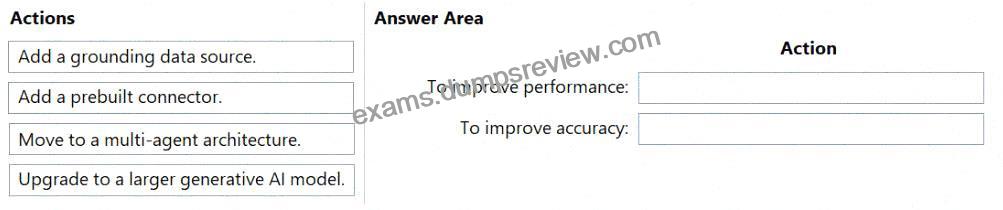
What should you include in the recommendation? To answer, drag the appropriate actions to the correct requirements. Each action may be used once, more than once, or not at all.
Explanation:
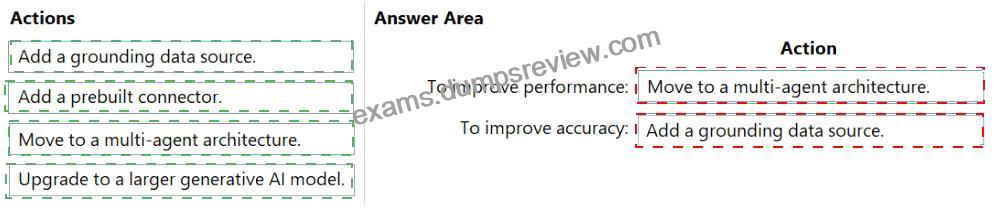
To improve performance # Move to a multi-agent architecture
To improve accuracy # Add a grounding data source
The current design uses a single agent and a single prompt to complete a series of tasks . That is often a bottleneck. When one agent is responsible for everything, it has to manage multiple steps, multiple reasoning modes, and multiple task transitions in one flow. This commonly leads to:
* slower response times
* task overload
* incomplete outputs
* reduced efficiency as complexity grows
Moving to a multi-agent architecture helps performance because tasks can be separated by function. For example:
* one agent can handle task planning
* another can retrieve domain knowledge
* another can perform structured reasoning
* another can prepare the final response
From an agentic AI systems perspective, decomposition improves throughput and execution quality. Instead of one overloaded agent trying to do everything, specialized agents handle narrower responsibilities. That often reduces latency in practical enterprise designs and improves the reliability of task completion.
This also addresses the symptom of incomplete results , because a multi-agent architecture can break a large workflow into smaller, controlled substeps.
Why “Add a grounding data source” improves accuracy
The agent struggles with domain-specific reasoning . That strongly suggests it lacks sufficient domain context during inference.
The best way to improve accuracy in this case is to add a grounding data source .
Grounding means giving the model access to trusted, relevant business knowledge at runtime, such as:
* internal documentation
* product specifications
* policy manuals
* knowledge bases
* industry-specific reference data
This improves domain-specific reasoning because the model no longer relies only on general pretrained knowledge. Instead, it can anchor its responses in authoritative content.
From an AI business solutions standpoint, grounding is one of the most important mechanisms for improving:
* factual relevance
* domain accuracy
* consistency
* trustworthiness
* explainability in enterprise contexts
When a model is inaccurate because it lacks business context, grounding is usually a better first fix than simply scaling model size.
Why the other actions are not the best fit
Add a prebuilt connector
A prebuilt connector helps with integration to systems and services, but it does not directly solve slow reasoning, incomplete output, or weak domain-specific reasoning unless the issue is specifically missing access to an external system. That is not the main problem described here.
Upgrade to a larger generative AI model
A larger model may sometimes improve reasoning quality, but it usually comes with higher cost and often slower response times , which works against the stated performance issue. It is not the best recommendation when the current agent is already slow.
Also, when domain-specific reasoning is the problem, grounding is usually more efficient and more controllable than simply choosing a larger model.
Expert reasoning shortcut
Use this exam logic:
* Slow and overloaded single agent handling many tasks # move to multi-agent architecture
* Weak domain-specific reasoning # add grounding data source
* Need system integration # prebuilt connector
* Need raw generative capability increase, but can accept more cost/latency # larger model